Quiet forest streams and subtle human traces in the Spessart
The Spessart offers many places that feel almost enchanted, including the Aubach valley and its spessart forest streams around Aubachsee. Yet unlike the Breitsee, the Spessart meadows, or the Weihersgrund—places where I felt irresistibly drawn into a fairytale-like world—this atmosphere revealed itself much more slowly here.
I had to work for it.
For that reason, the Aubachsee and the Aubach valley, as fascinating as the discovered locations were, do not belong to the places that keep calling me back in the same way the Spessart meadows do. Their quiet character unfolds only with patience.
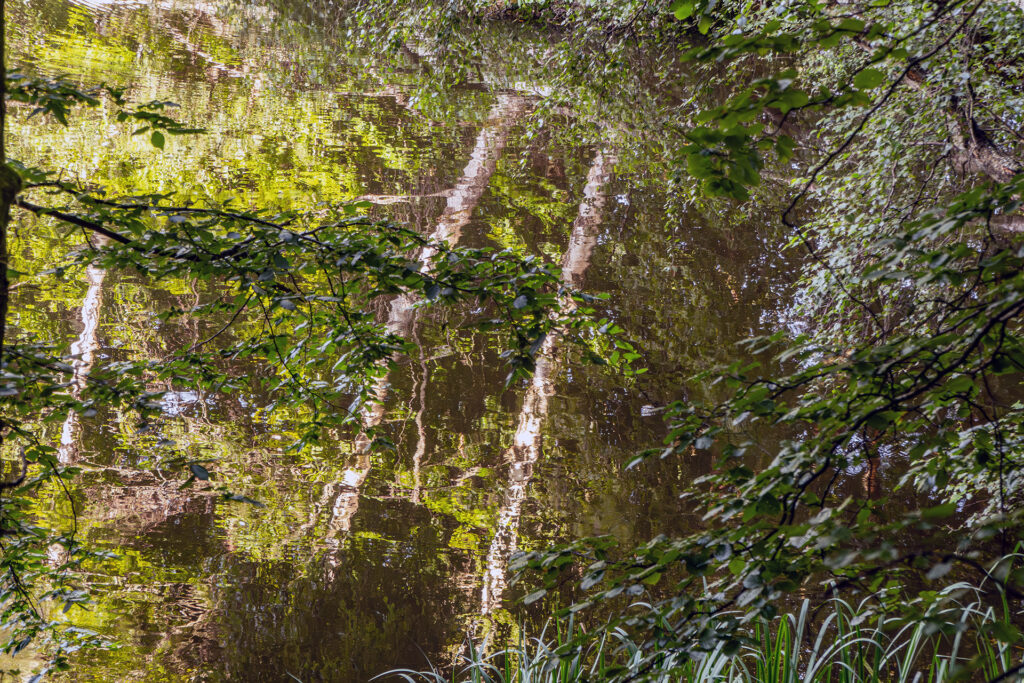
Lakes hold a particular fascination for me, and so I chose Aubachsee as my starting point. It is, however, a rather modest and restrained lake—well suited for a Sunday afternoon walk. Only by looking more closely did I begin to notice moments of atmosphere, such as reflections hidden away in a quieter corner of the lake.
The more memorable impressions appeared once I turned my back on the Aubachsee and followed the course of the Aubach itself. Leaving the lakes behind opened a different kind of landscape. Southeast of the Aubach lakes—an area that is, in fact, divided into three sections—one can drive east of Krommenthal along the state road ST2317, running parallel to the stream toward Partenstein. Along this route, several railway bridges built from regional red sandstone come into view.
Constructed from local Buntsandstein, these bridges speak of a time when engineering followed the rhythm of the landscape and the Spessart provided its own materials.
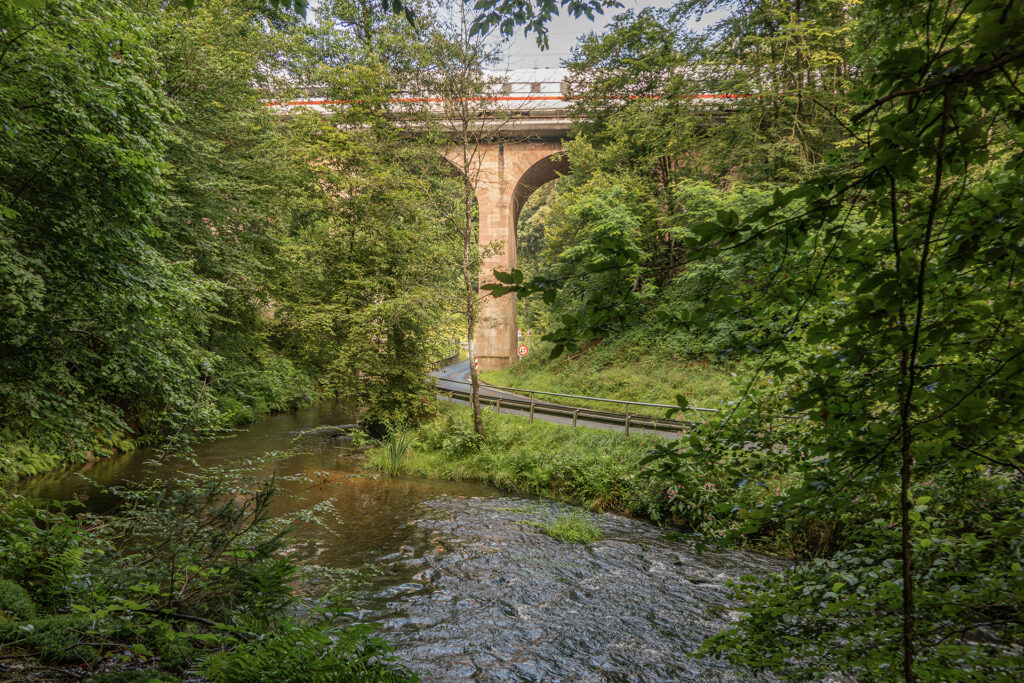
Forest paths accompany the Aubach along parts of its course, but they are not easily accessible due to the lack of proper parking areas. The most rewarding spots are not reached casually; they require long walks and a willingness to slow down.
Near Partenstein, a good starting point is the area around Burg Bartenstein. From there, forest paths lead through the Spessart. Views of the village itself are rare, which makes the moment all the more magical when houses suddenly appear, shimmering through branches and leaves.
Parking and Ways to Experience the Aubach
For a walk around Aubachsee, parking is available near the Fischerhütte inn at
N50° 03.252′ E9° 24.911′,
or at a slightly larger parking area about 120 meters south of the inn at
N50° 03.199′ E9° 24.965′.
Both locations provide direct access to the Aubach lakes. A full loop around the lakes measures approximately 1.5 km.
North of the Aubach lakes, smaller cars can be parked at the entrance to a forest track at
N50° 03.716′ E9° 24.800′.
From here, there is a pleasant view into the upper Aubach valley and toward the Habichtsthal mill.
At N50° 01.685′ E9° 27.629′, it is possible to park along a small forest access road. From this point, one has a clear view of one of the red sandstone railway bridges and the now noticeably larger Aubach. A forest path follows the stream, although the parking area and the first 200 meters of the trail offer the most rewarding impressions.
In Partenstein, there is also a small free parking area for motorhomes at
N50° 02.701′ E9° 30.768′.
From there, it is about 1.2 km to Burg Bartenstein. A forest path continues along the Lohr river, which was heavily overgrown at the time of my visit. The first kilometer still provides interesting insights into the Spessart forest before the path becomes increasingly difficult to follow.
Background Information: Aubachsee, Aubachtal, and Burg Bartenstein
Aubachsee lies within the Spessart forest and forms part of a small interconnected system of lakes and streams. The surrounding landscape is shaped by mixed woodland, gentle slopes, and quiet watercourses. While the lake itself appears calm and understated, it serves as an entry point into a more varied and Aubachsee is located in the Spessart Forest and is part of a small, interconnected system of lakes and streams. The surrounding landscape is characterised by mixed forests, rolling hills and tranquil waterways. The lake itself appears calm and unassuming, but serves as a gateway to a more diverse and sometimes less accessible environment.

Flowing southeast from the lake system, the Aubach passes through the narrow, forested Aubach valley. Over time, the stream increases in size and is accompanied by woodland paths and stretches of road that follow its course. The character of the valley reveals itself gradually, rewarding exploration on foot rather than at a glance.
A distinctive feature of the Aubach valley is the presence of historic railway bridges constructed from regional red sandstone. Built during the expansion of railway infrastructure in the 19th century, these structures reflect a period when engineering was closely connected to local materials and the surrounding landscape. Their arches remain a subtle but enduring element of the Spessart valley.
Above the nearby village of Partenstein stands Burg Bartenstein. Although no images of the castle are included in this gallery, it serves as an important historical reference point. From its elevated position, it once controlled movement through the Lohr valley and the surrounding forest routes, linking natural corridors with human settlement.