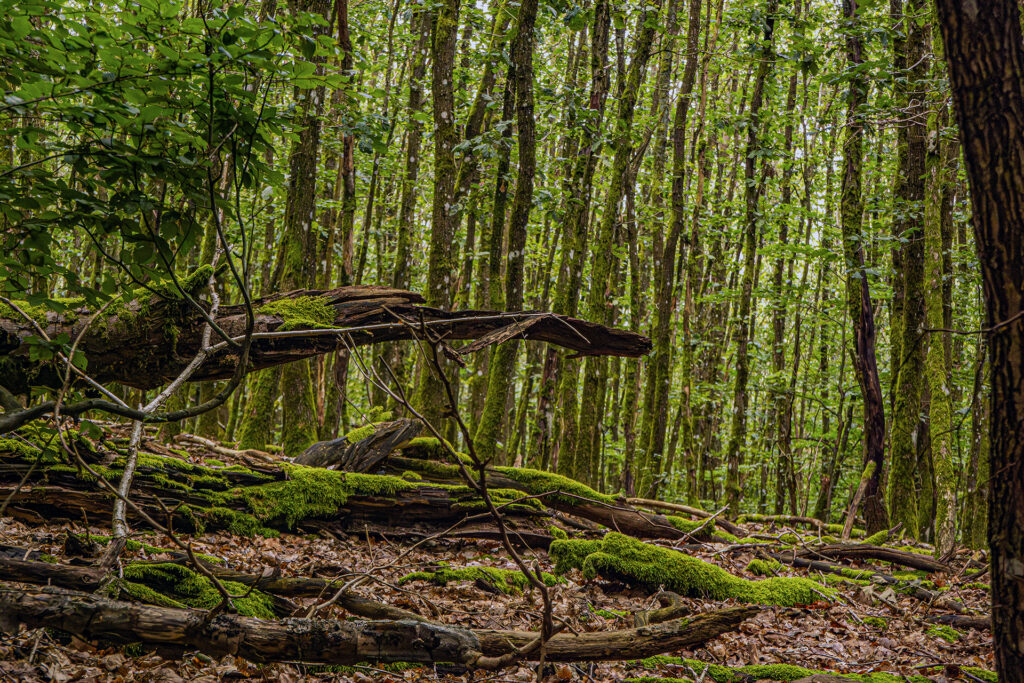
Forest remnants Spessart can feel like a museum of abstract art shaped by time rather than intention.
The Spessart as a Gallery of Abstract Nature
Anyone who walks through the Spessart expecting spectacular sights may be disappointed.
The Spessart reveals itself not as a place of sensation, but as a quiet wonder for the sensitive soul.
To experience it fully, one must seek out those areas untouched by economic interests – places where efficiency has lost its authority. Small protected zones such as Kreuzbuckel, Gaulkopf, Hoher Knuck, the Grey Heron Colony, or the Haibacher Schweiz feel less like forests and more like a gallery of abstract art.
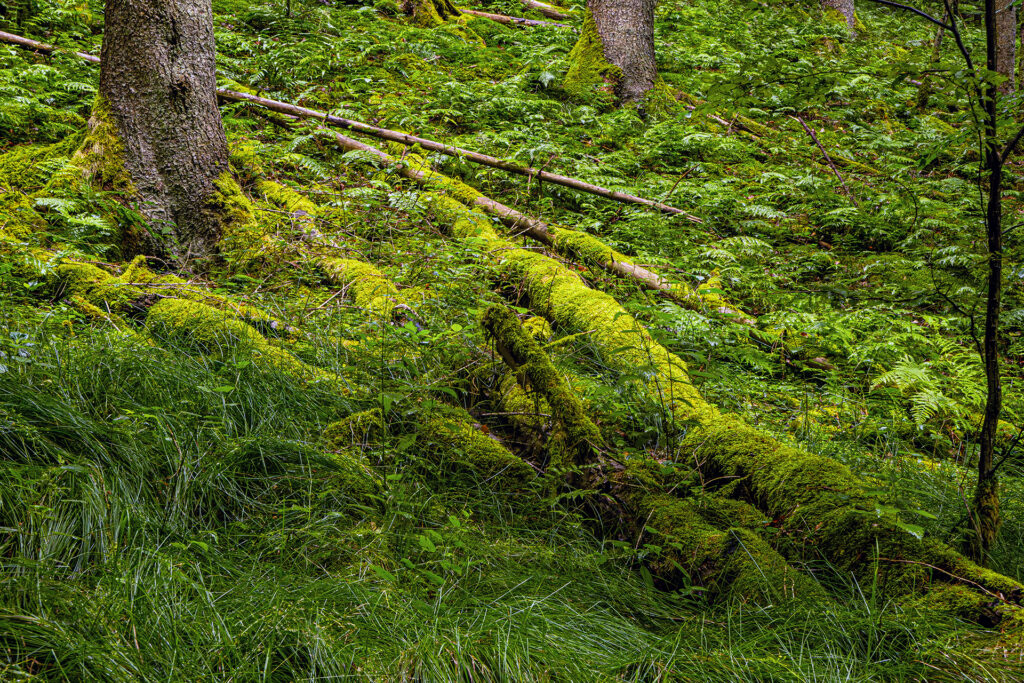
Freed from the constraints of utilitarian thinking, nature’s creativity unfolds without limits. Fallen trunks become sculptures, moss turns into texture, and decay transforms into composition.
Three forest quotes that resonate deeply with this experience:
“And into the forest I go, to lose my mind and find my soul.”
John Muir
“One goes into the forest and sees only firewood.”
Leo Tolstoy
“For in the forests there are things over which one could lie in the moss for years, thinking.”
Franz Kafka
Parking and Ways to Experience the Spessart Forests
Hoher Knuck
It is unclear whether the parking area at the Pension Hoher Knuck (N49° 56.850′ E9° 27.000′) is officially public, but parking options are generally available.
From the pension, following the same coordinates, it is approximately 3 km to the edge of the nature reserve surrounding Hoher Knuck.
Gaulkopf
Near Erlenfurt, parking is possible along the roadside. The most practical starting point is where the forest track at N49° 56.733′ E9° 28.720′ leads toward Gaulkopf.
The walk to the edge of the protected area is about 1.2 km. From there, continue another 1.2 km along the outer boundary of Gaulkopf until reaching a hunting stand at N49° 57.908′ E9° 29.103′. At this point, a narrow path branches off to the right, leading directly into the heart of Gaulkopf.
⚠️ Note: This path may be overgrown and difficult to recognize. For those willing to accept a bit of uncertainty, it offers a particularly intense forest experience. The route through the reserve itself is no longer than 1.5 km.
Kreuzbuckel
To visit Kreuzbuckel, park in Waldaschaff at the parking area near the recreational grounds “Am Knückel” (N49° 58.084′ E9° 18.127′).
From there, follow the trail southwest and pass beneath the A3 motorway. After approximately 1.8 km, you reach the edge of the Kreuzbuckel nature reserve (N49° 57.465′ E9° 17.612′).
Walk about 500 m along the perimeter until you reach a narrow 1 km path entering deep into the reserve at N49° 56.997′ E9° 18.044′. At the end of this path, you can turn right and follow the outer edge of Kreuzbuckel back toward your starting point.
On the way to Kreuzbuckel, you will also cross the Gänseweg (N49° 57.820′ E9° 18.101′), a beautiful trail that can be followed in either direction, offering open views into the valley and toward Waldaschaff.
Steinbruch Noriswand & Former Aschaffenburg Military Training Area
If you want to combine two destinations in one walk, park at the Schützenhaus St. Sebastianus. From there, it is about 600 m to the Noriswand Quarry (N49° 56.897′ E9° 11.441′), which resembles a short, unexpectedly dramatic canyon.
In the opposite direction lies the former Aschaffenburg military training area, now designated as a nature reserve. This open landscape is home to Przewalski’s horses, a species once on the brink of extinction. Through dedicated breeding programs, these Mongolian wild horses were saved and are now being reintroduced into semi-wild conditions.
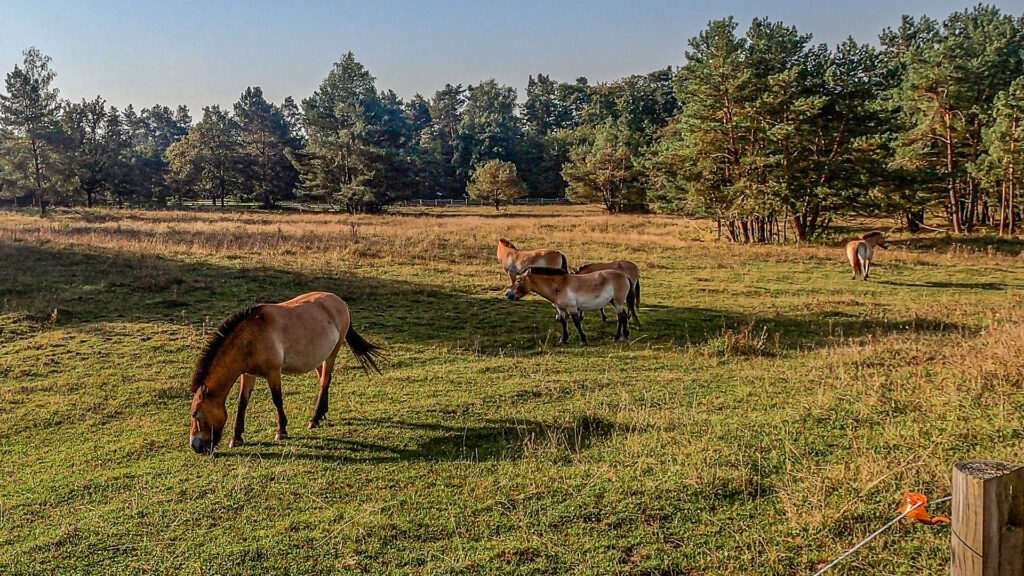
For those focusing solely on the training area – locally known as the “Exe” – parking at Ebersbacher Straße (N49° 56.467′ E9° 10.365′) is recommended. A full loop around the area, with views across the grazing grounds, is approximately 3.2 km.
⚠️ Important: Sightings of the horses are not guaranteed. They roam freely and have many opportunities to retreat from view.
From this parking area, another scenic walk follows the Hügelsbach stream, which later becomes the Altenbach. The Elbertsbrunnen spring (N49° 56.003′ E9° 10.047′) offers a pleasant resting spot before crossing the Altenbach about 170 m further downstream to return to the parking area.
⚠️ Safety notice: As this was a former military training ground, unexploded ammunition may still be present. Do not leave marked paths. All known risk areas are fenced off.
Grey Heron Colony at Salzberg
There are no official parking areas near the Grey Heron Colony, but it is possible to park along the roadside at N50° 01.206′ E9° 37.515′.
From there, follow the path running parallel to the Steinlesgraben stream. At the forest edge, turn left and continue along the woodland boundary until reaching the Sommerhof, where you turn left again toward the Main River.
⚠️ Note: There is no direct route; expect several detours and loops.
Once at the Main, follow the cycle path parallel to the main road back toward the parking area.
Alternatively, you can make a detour to the Salzberg hill (N50° 01.261′ E9° 38.795′) and either return the same way or continue on to Sommerhof (N50° 01.107′ E9° 39.328′).
Background Information
Hoher Knuck
Hoher Knuck is a forested elevation within the Spessart, characterized by mature mixed woodland and minimal human disturbance. Its remoteness and limited accessibility have allowed natural processes such as decay, regeneration, and deadwood accumulation to shape a highly atmospheric forest structure.
Gaulkopf
Gaulkopf is a small but dense forest reserve known for its wild character. Narrow paths, fallen trees, and thick undergrowth create an almost primeval atmosphere. It is particularly valued for its untouched forest floor and the feeling of complete immersion it offers.
Kreuzbuckel
Kreuzbuckel is a protected forest area distinguished by old-growth stands and a high proportion of deadwood. The terrain is gently undulating, and the forest interior feels enclosed and intimate, making it an excellent example of near-natural Spessart woodland.
Steinbruch Noriswand
The Noriswand quarry is a former stone extraction site that has since been reclaimed by nature. Steep rock faces, unusual light conditions, and spontaneous vegetation give it a canyon-like appearance and a strong visual contrast to the surrounding forest.
Former Aschaffenburg Military Training Area
Once used for military exercises, this open landscape has been converted into a nature reserve. Its mosaic of grasslands, shrubs, and sparse woodland provides ideal conditions for rare species. The area is notable for its role in the reintroduction of Przewalski’s horses, which now help maintain the landscape through natural grazing.
Grey Heron Colony
The Grey Heron Colony near Salzberg is one of the quieter wildlife areas in the region. Tall trees near water sources provide ideal nesting conditions. During breeding season, the colony is particularly sensitive, and visitors are encouraged to keep a respectful distance.