A City Where Time Moves More Gently ←
Würzburg is my secret capital.
Although officially the administrative seat of Lower Franconia, the city combines an urban atmosphere with a surprisingly rural calm. Strolling through streets lined with Rococo and Baroque buildings, one is lulled into an almost fairytale-like quiet despite the lively activity all around.
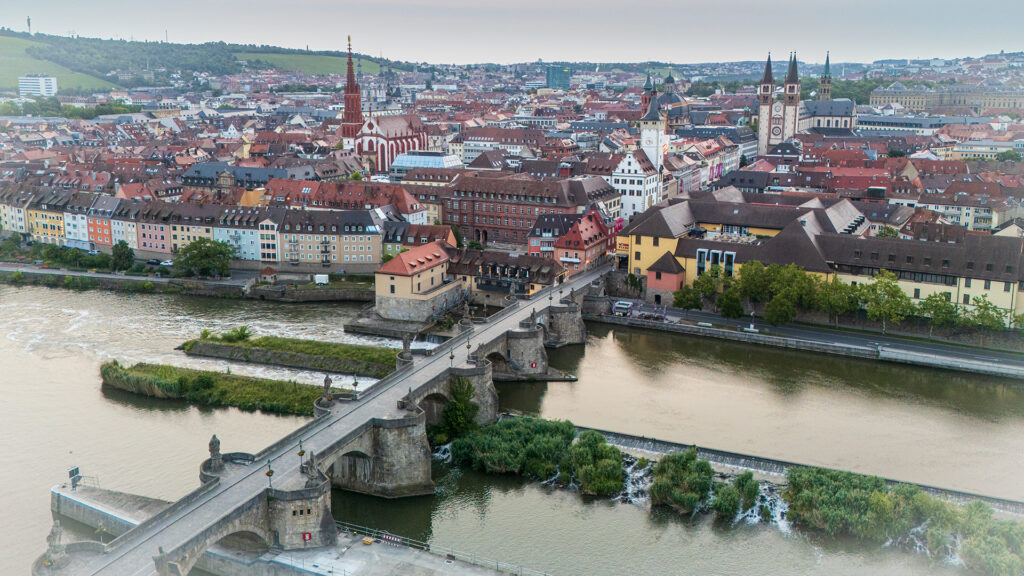
Perhaps it was also the season in which I visited Würzburg. In the warm evening light of early summer, I walked across the Old Main Bridge with the feeling that time itself slowed down here.
The Old Main Bridge is Würzburg’s oldest bridge and one of its defining landmarks. Until 1886 it was the city’s only crossing over the River Main. Construction began in 1476 and was not completed until 1703 — almost 150 years later. Even during its building period, time seemed to pass at a different pace.
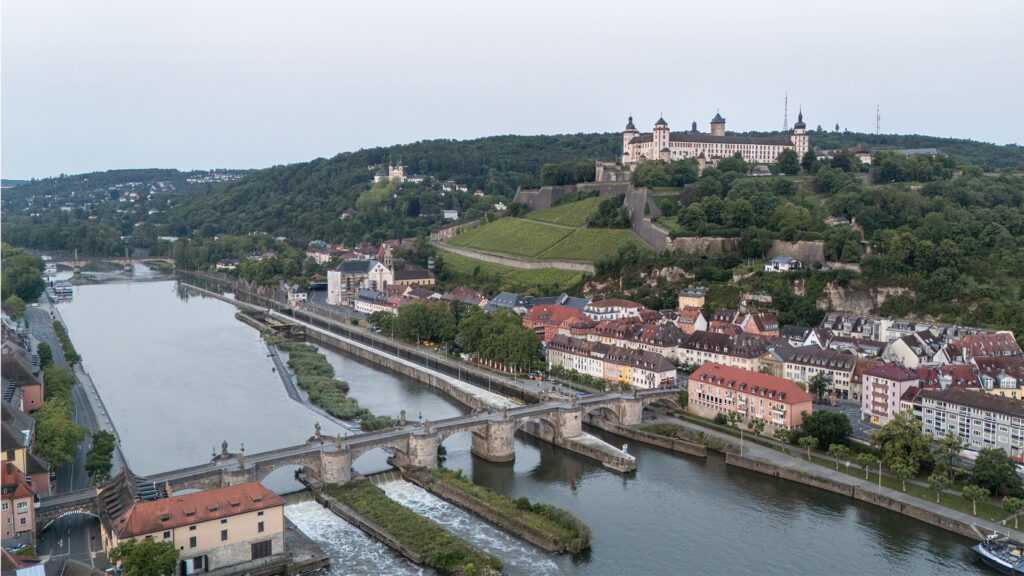
From the right spot along the riverbank, a remarkable view opens up toward two of the city’s most important landmarks: the Old Main Bridge in the foreground and, towering above everything, Marienberg Fortress.
The history of the fortress stretches back several millennia. A fortified settlement existed here already during the transition from the Bronze Age to the Iron Age, and a Celtic ring wall is documented from the 1st millennium BC. The oldest surviving structure today is St. Mary’s Church from the early 11th century, while one of the youngest additions — the Maschikuliturm bastion tower — was completed in 1729.
Although Würzburg is primarily known for its Baroque and Rococo architecture, Gothic architecture stands confidently beside it in the form of the Marienkapelle.
And so I simply let myself drift along with the long history of Würzburg and its magnificent buildings — forgetting space and time, eating an ice cream, warmed by the evening sun, my thoughts suspended in a quiet trance.
Parking and Ways to Experience Würzburg
If you do not mind a bit of walking, the free parking area along the River Main (N49° 46.694′ E9° 55.724′) is a good option. However, it is just over 2 km to the Old Main Bridge.
A quieter alternative in a natural setting — next to a playground — can be found at N49° 46.925′ E9° 54.813′. This is also a suitable overnight spot for camper vans.
If you want to save about 500 meters of walking uphill to Marienberg Fortress, continue to the Käppele parking area. During high season it will likely be busy. From there it is a little over 1 km to the fortress and about 1.5 km to the Old Main Bridge.
Important Coordinates
- Marienberg Fortress — N49° 47.391′ E9° 55.268′
- Old Main Bridge — N49° 47.579′ E9° 55.533′
- Würzburg Residence — N49° 47.575′ E9° 56.326′
- Marienkapelle — N49° 47.691′ E9° 55.767′
- St. Kilian’s Cathedral — N49° 47.607′ E9° 55.902′
Background Information
Würzburg is one of the historic cultural centers of Franconia and developed early as a religious and political power seat. For many centuries it was ruled by the Prince-Bishops, who shaped the city’s appearance more than anything else. Their ambition turned Würzburg into one of southern Germany’s most important Baroque cities.
The most famous building is the Würzburg Residence, constructed in the 18th century and today a UNESCO World Heritage Site. It is considered one of the greatest Baroque palaces in Europe, particularly because of the monumental staircase hall and the world-largest ceiling fresco by Giovanni Battista Tiepolo.
Above the city rises Marienberg Fortress, originally the seat of the Prince-Bishops before the Residence was built. For centuries it served both as a defensive stronghold and a symbol of ecclesiastical authority over the region.
The Old Main Bridge, modeled partly after the Charles Bridge in Prague, connected the episcopal residence with trade routes and made Würzburg an important economic hub along the River Main.
The Marienkapelle, a masterpiece of late Gothic architecture, stands on the site of the medieval Jewish quarter and represents the city’s religious transformation during the late Middle Ages.
Finally, St. Kilian’s Cathedral — one of the largest Romanesque churches in Germany — reflects Würzburg’s role as a major bishopric since the early Middle Ages and remains the spiritual center of the region today.