When Buildings Shape the Memory of a Place
Castles in Lower Franconia are not always found in picturesque towns.
Burgsinn, Rieneck and Werneck do not possess the gentle charm of Franconian towns such as Bischofsheim in der Rhön, Bad Neustadt an der Saale or Hammelburg. They are places one might easily pass without stopping — if it were not for the buildings rising above them.
These stone landmarks command attention. The eye lingers on them while everything else fades into the background. They awaken the imagination and pull it toward distant centuries. Long after the visit, it is not the towns that remain in memory, but the structures themselves.
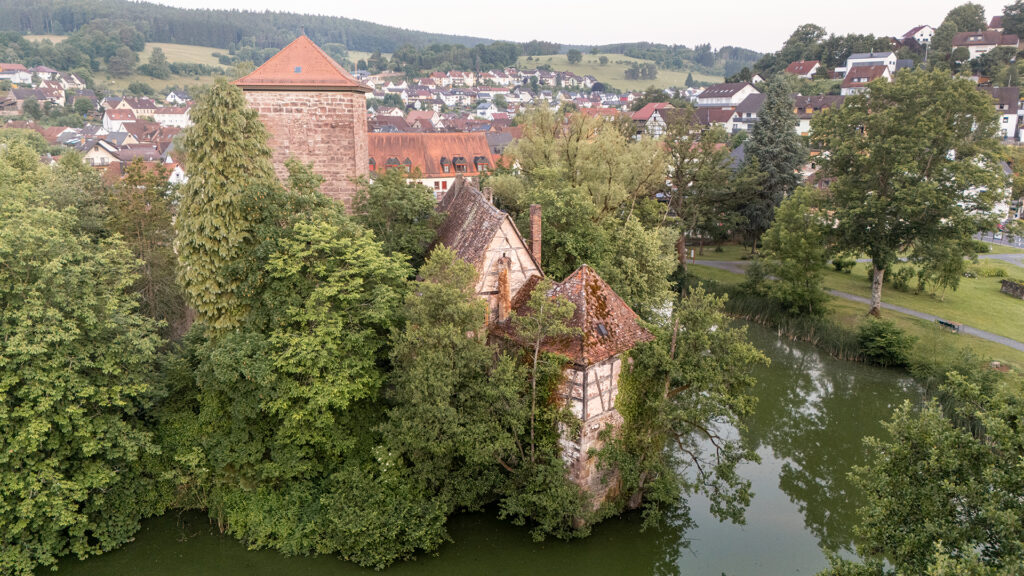
The Alte Burg in Burgsinn — a small moated castle — leads me into a world of fairy tales. Surrounded by water and almost hidden within trees, it feels like a forgotten place. It does not matter that only the tower and parts of the half-timbered buildings are visible. They are enough to create the image of an enchanted castle, something reminiscent of Sleeping Beauty.
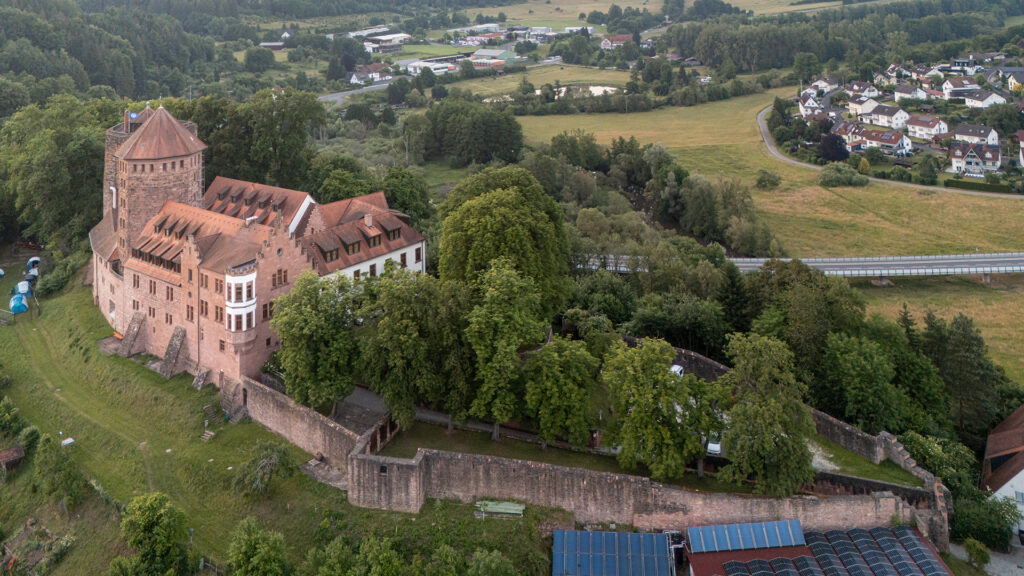
High above the town of Rieneck rises a very different sight. The massive hilltop castle appears powerful and almost intimidating. Built around 150 years after the early foundations of Burgsinn, it represents a harsher reality. One cannot help but wonder how many conflicts it endured, how many sieges it witnessed. Here, imagination moves away from fairy tales toward history.
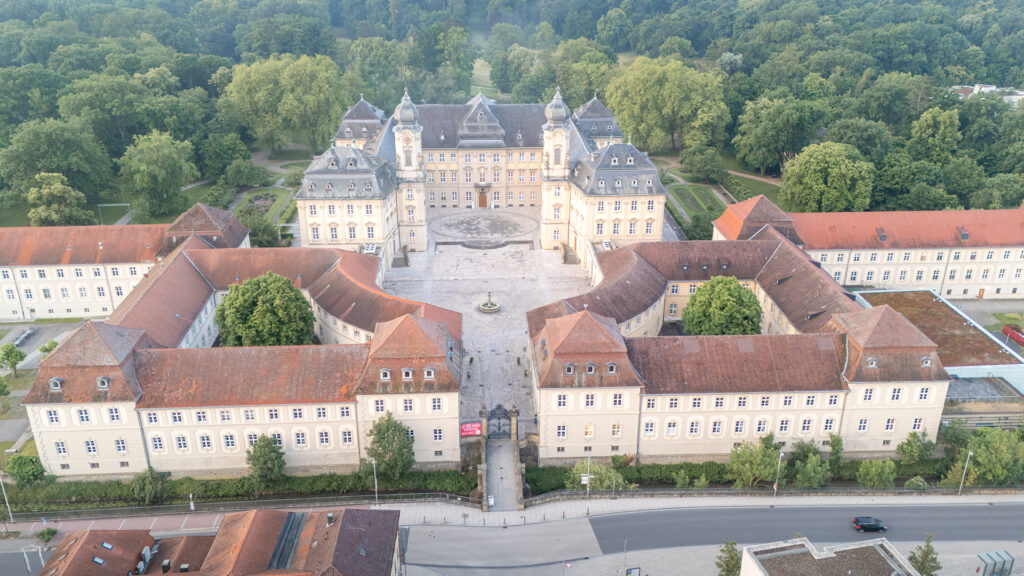
Werneck Palace finally reveals yet another form of power — not defensive, but representative. The baroque residence, considered one of the most mature secular works of the architect Balthasar Neumann, was designed to impress rather than to protect. I imagine it as a place of ceremony and social life, where prestige mattered more than security. Today, the building serves a completely different purpose as a hospital for orthopedics and psychiatry.
Parking and Ways to Experience
Burgsinn
Parking is available near the outdoor swimming pool (N 50°8’42.2592” E 9°39’15.12”). It is also an official free motorhome parking area. The Alte Burg is only about 370 m away on foot.
Rieneck
A spacious free parking area lies on the opposite side of the Sinn river, suitable for motorhomes, although relatively close to a road. It should be quiet at night. From here you already have a good view of the castle, and it can also be reached by a short walk of about 500 m.
Werneck
Near a sports field and away from traffic noise there are several parking possibilities (N49° 59.080′ E10° 06.292′). The palace is less than 900 m away. A small footpath allows you to avoid the main road. If navigation apps do not show it, heading toward the palace coordinates usually reveals the route.
Background Information — From Fortress to Residence
The three buildings illustrate the historical transformation of power in Franconia.
Medieval castles such as Burgsinn and Rieneck were built primarily for control and defense. Their locations — surrounded by water or placed high above valleys — allowed observation of trade routes and provided protection during conflicts. Architecture followed necessity.
By the 18th century this changed. Baroque residences like Werneck Palace no longer needed to withstand attacks. Instead, they expressed authority through symmetry, size and elaborate design. The focus shifted from military security to social representation and administrative presence.
Seen together, the sites form a small timeline:
from fortified refuge, to territorial stronghold, to architectural prestige.
And that is why these places remain memorable — not because of the towns around them, but because the buildings still communicate the ideas of the centuries that created them.