Quiet Townscapes of Lower Franconia Discovered Along the Way
Gemünden am Main and Rothenfels will probably never appear on any global ranking of cultural highlights. They are small, quiet towns in Lower Franconia — unassuming at first glance, yet marked by a very particular atmosphere. I encountered both of them almost by chance while cycling through the Spessart, and that accidental discovery is exactly what made them stay with me.
In both cases, it was the view from a distance that fascinated me most, not the close-up details. That is why this gallery consists exclusively of panoramic perspectives.
Gemünden am Main marked the end of my journey along Spessartweg No. 1. After hours of cycling through the dense, often dark forests of the Spessart, the moment when the Main valley suddenly opens up feels almost overwhelming. Where the rivers Sinn and Franconian Saale merge and flow into the Main, Gemünden appears below — bathed in light, open, and unexpectedly vibrant. The contrast between the enclosed forest landscape and the wide river valley could hardly be stronger.
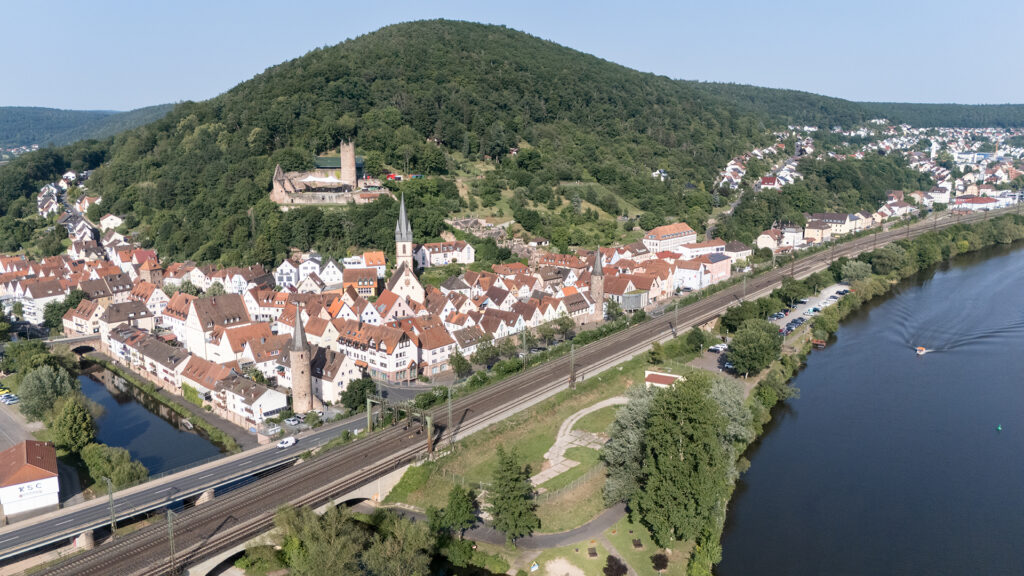
I came across Rothenfels while riding along the 154-kilometre Maintalhöhenringweg. From the opposite side of the river, the town immediately caught my eye — not through landmarks or size, but through the compact composition of its houses clinging to the slope beneath the castle. Unfortunately, the Main Valley Ridge Trail is no longer well maintained. Signage is missing in many sections, and long stretches have become overgrown, making the route more challenging than expected.
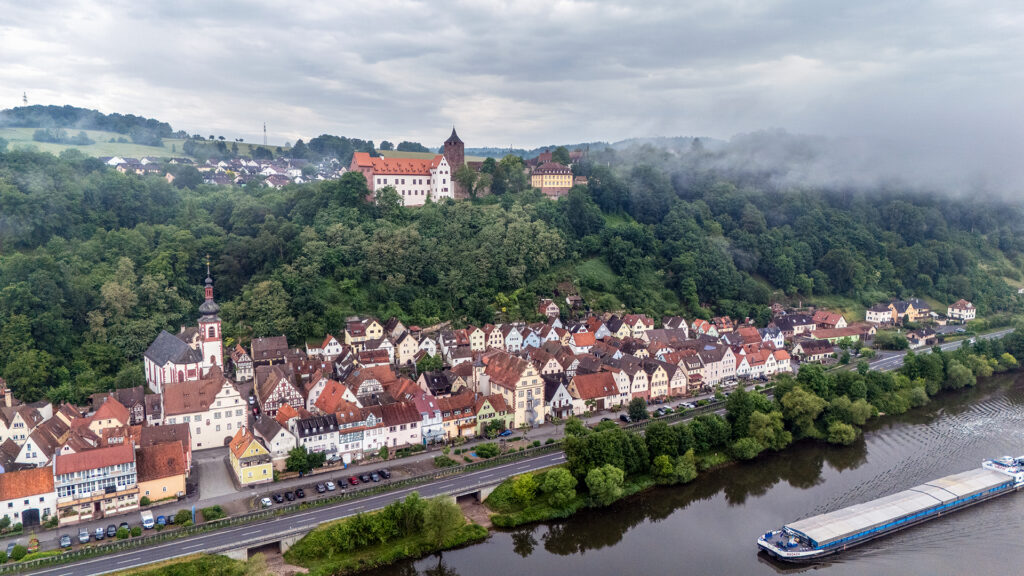
What these two towns share is surprisingly little, and yet enough to connect them in this gallery: both are so small that you can cross them on foot within minutes; both long-distance routes originally start in Aschaffenburg; and in both cases, a castle rises above the town. From there, however, their paths clearly diverge.
Two Towns, Two Characters
Burg Rothenfels today serves as a centre for youth and adult education and is not freely accessible. The Scherenburg in Gemünden, on the other hand, is open to the public. Its viewing platform offers wide panoramas over the Main and Saale valleys, and during summer the castle becomes a cultural focal point through the Scherenburg Festival.
Gemünden am Main is also a natural hub for outdoor activities. Numerous hiking and cycling routes either begin or end here — among them the Spessartweg Nr. 1, the Birkenhainer Straße, and the Rhön-Sinntal-Radweg. Canoeists are equally well catered for, as both the Sinn and the Franconian Saale can be explored from this point. Accordingly, the town is well prepared for visitors, with cafés, restaurants, a campsite, and a large outdoor swimming pool.
Rothenfels, by contrast, feels more like a place you pass through rather than stay in. Yet those who take the time to walk along the single road that runs through the town — the Hauptstraße — will discover something unexpected: peculiar houses adorned with countless small objects, decorations, and curiosities. Together, they create a highly individual, almost fairy-tale-like atmosphere that reveals itself only at a slower pace.
Parking and Ways to Experience Rothenfels
For those wishing to explore Rothenfels, three larger parking areas are located directly along the Main and are easy to reach:
- N49° 53.493′ E9° 35.578′
- N49° 53.520′ E9° 35.558′
- N49° 53.571′ E9° 35.508′
I personally preferred the small parking area near the cemetery at N49° 53.348′ E9° 35.676′, as it lies at the beginning of the Hauptstraße. From there, it is only about 200 metres into the town, allowing you to immediately experience its distinctive character.
The most beautiful view of Rothenfels is undoubtedly from the opposite side of the Main at N49° 53.587′ E9° 35.635′. Unfortunately, I could not find a suitable parking spot nearby, as the settlement there is very small and narrow. I therefore parked above the village at N49° 53.944′ E9° 36.267′, which still offers a fine view over the Main valley.
Parking and Ways to Experience Gemünden am Main
A free parking area is available near the outdoor swimming pool at N50° 03.580′ E9° 41.423′ (Duivenallee). About 50 metres before that, there is a very small paid motorhome parking area at N50° 03.524′ E9° 41.350′. From both locations, it is roughly a 500-metre walk to the old town. The Sinntal cycle path also begins nearby.
Parking is also possible directly at the Main riverbank (Mainlände). However, I am not certain whether this area requires a parking disc or payment, and access for larger vehicles may be restricted. The railway underpasses in this area are particularly narrow.
Background Notes
Although Gemünden am Main and Rothenfels may appear modest in size, their locations are anything but incidental. Both towns developed at strategically important points along the Main, where trade routes, river crossings, and later railway connections shaped their history. The castles above them were not merely symbols of power but practical instruments of control over the river traffic below.
Today, much of that historical significance has faded into the background, leaving behind places that feel calm, almost understated. It is precisely this absence of spectacle that gives these towns their quiet appeal — places discovered not through guidebooks, but through movement, curiosity, and the willingness to take a slower path.