Why Half-Timbered Towns on the Main Feel Like Home to Me
Half-timbered houses have always carried a special atmosphere for me. Living in one is not just about architecture – it is a way of life. Unlike modern buildings shaped by strict standards and efficiency, half-timbered houses feel individual, irregular, and personal.
I had the privilege of living in a half-timbered house for several years before I eventually gave it up in favor of a nomadic lifestyle. That experience left a lasting impression on me and strongly shaped the way I perceive historic towns today.
My hometown, Rothenbuch, naturally has its share of half-timbered houses – after all, I lived in one myself. But when it comes to my personal favorites in Lower Franconia, two towns stand out clearly: Lohr am Main and Miltenberg.
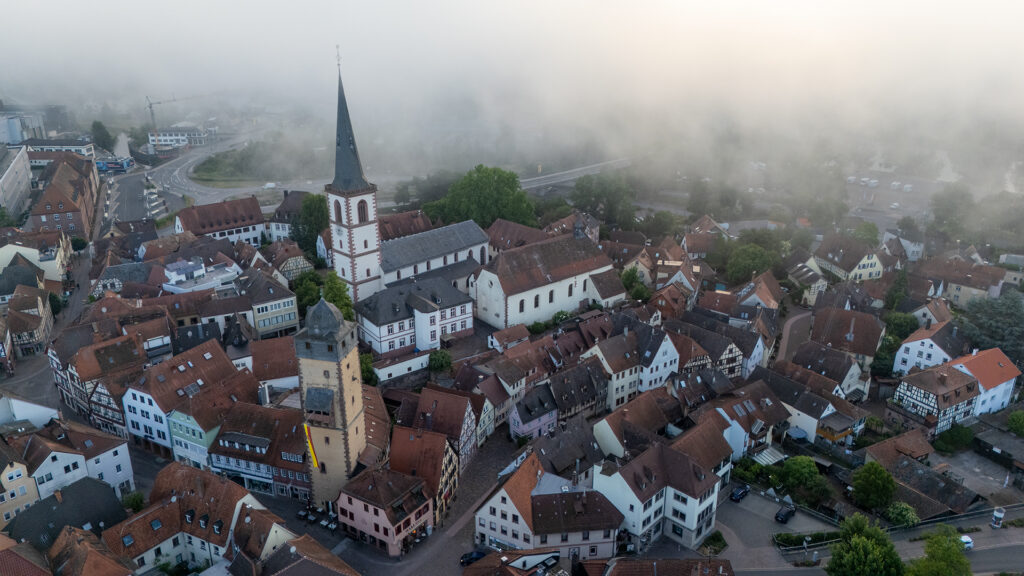
Lohr am Main is widely known as a “fairytale town,” especially through its association with Snow White. I have always found this connection intriguing, but also somewhat puzzling. The Brothers Grimm spent a significant amount of time in Hanau, which lies about 50 kilometers from Lohr. Whether they ever visited Lohr remains uncertain. What becomes clear, however, when looking more closely at the historical background, is that the Snow White narrative linked to Lohr is largely speculative and has been amplified over time for cultural and tourism purposes.
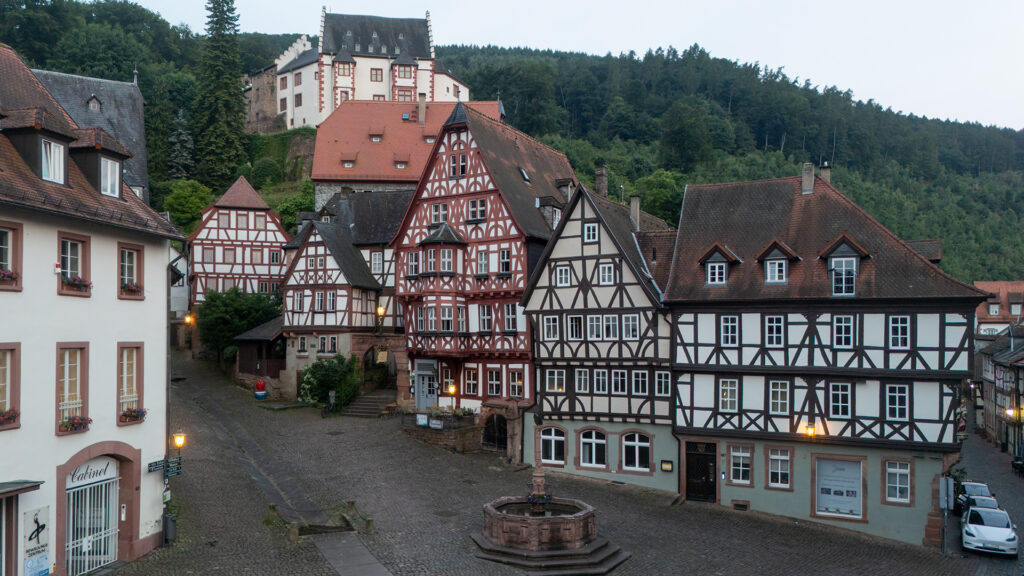
Miltenberg, on the other hand, convinces me through the strength of its overall composition. The density of its half-timbered houses, the harmony between market square, church, castle, and surrounding landscape create a coherence that Lohr cannot quite match. Despite my appreciation for Lohr, parts of its historic character are visually dominated by the Rexroth industrial complex. For me personally, Miltenberg therefore remains the undisputed number one among the half-timbered towns along the Main.
Snow White and Lohr am Main – Between Myth and Interpretation
The idea that Lohr am Main could be the inspiration for the Snow White fairytale is based on a series of historical interpretations rather than proven facts. One frequently mentioned figure is Maria Sophia von Erthal, a noblewoman from Lohr whose life shares certain elements with the fairytale narrative. However, historians largely agree that these similarities are circumstantial and do not provide solid evidence for a direct connection.
Over the years, this interpretation has gained momentum and has become an integral part of Lohr’s cultural identity. While the story is appealing and well suited to storytelling, it remains a modern construct rather than a historically verifiable origin of the Snow White tale. A critical look reveals how legends can evolve when history, local pride, and tourism intersect.
Sources:
– Süddeutsche Zeitung, “Lohr Schneewittchen – Die nächste…”
– City of Lohr am Main, “Märchen und Realität”
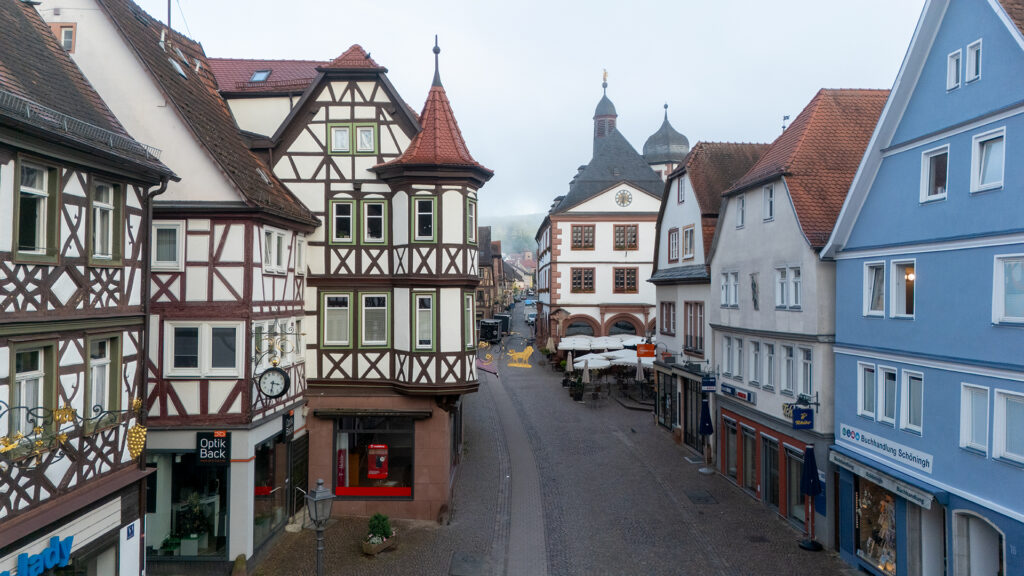
Parking and Ways to Experience Lohr am Main
The main parking area directly along the Main River
N49° 59.653′ E9° 34.817′
is a good starting point for exploring the town on foot. Within less than 150 meters, you reach the old fishermen’s quarter with its small, charming half-timbered houses. Another 150 meters further and you are already close to the historic center.
Parking for motorhomes is possible here, but it is subject to a fee. At night, the area can become noisy due to illegal street racing by young drivers, although this issue may have been addressed in the meantime.
A quieter alternative is the Westangente parking area:
N49° 59.345′ E9° 34.434′
From here, it is about 500 meters to the old town. Parking is free, less scenic than by the river, but completely quiet and well suited for overnight stays.
Parking and Ways to Experience Miltenberg
On the opposite side of the Main River, there is a free motorhome parking area next to a campsite:
N49° 42.264′ E9° 15.327′
From there, it is an 800-meter walk to the old town.
Alternatively, you can park directly along the Main close to the historic center. Large paid parking areas are available at:
N49° 42.027′ E9° 15.176′
From here, the distance to the old town is only about 50 meters.
Background Information: Lohr am Main and Miltenberg
Lohr am Main and Miltenberg both developed along the Main River, which for centuries served as a vital trade route connecting Franconia with the Rhine region. Timber, wine, sandstone, and agricultural goods shaped the prosperity of these towns and left visible traces in their architecture and urban layout.
Lohr am Main grew as an administrative and industrial town, influenced by river trade and later by manufacturing. Its historic core is compact and rich in detail, while modern industrial structures on the outskirts reflect the town’s economic transformation over time. This contrast between medieval fabric and industrial expansion defines Lohr’s visual identity today.
Miltenberg, by contrast, developed more cohesively around its medieval core. Sheltered by wooded hills and dominated by Burg Mildenburg, the town preserved its historic structure with remarkable consistency. The market square, dense half-timbered streets, church towers, and riverside promenade form a tightly interwoven composition that has remained largely intact over centuries.
Together, Lohr am Main and Miltenberg illustrate two different paths of urban development along the Main River: one shaped by transformation and reinterpretation, the other by continuity and preservation. This contrast makes them especially compelling when viewed side by side.