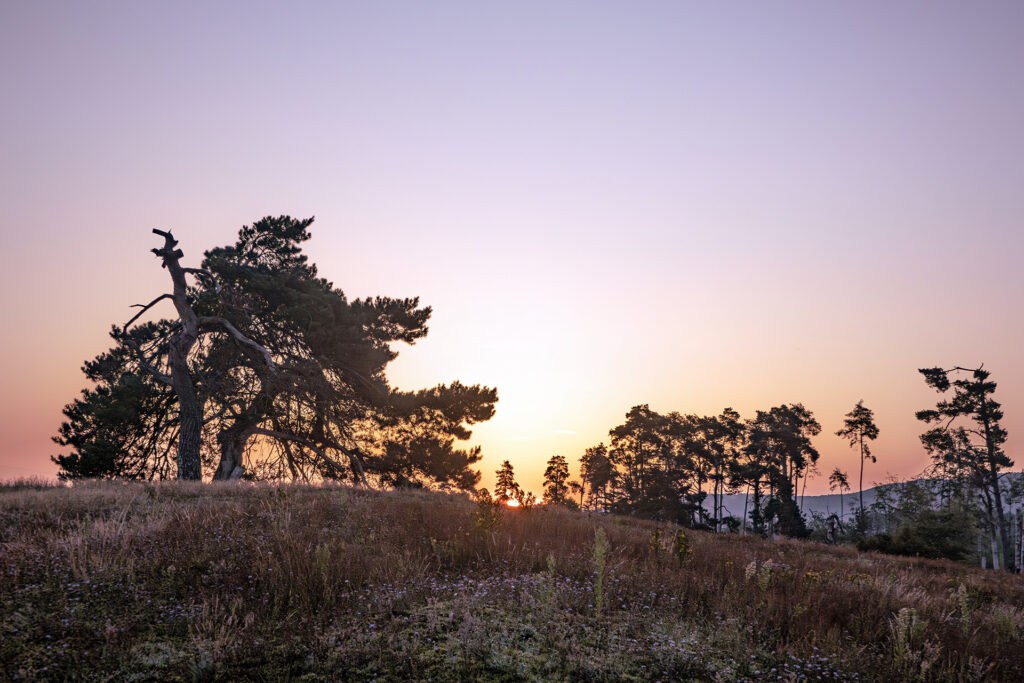
A Personal Encounter with a Landscape That Reveals Itself Slowly
The Alzenauer Sande are one of those places that seem unremarkable at first glance. I walked the Dr. Heinrich Degen Trail, a long-distance hiking route of over 52 kilometers through the Kahlgrund, twice before I truly noticed them. During my first hike, I passed through without realizing what I was walking across. The second time, I arrived with a bit of background knowledge—and suddenly, the landscape began to unfold.
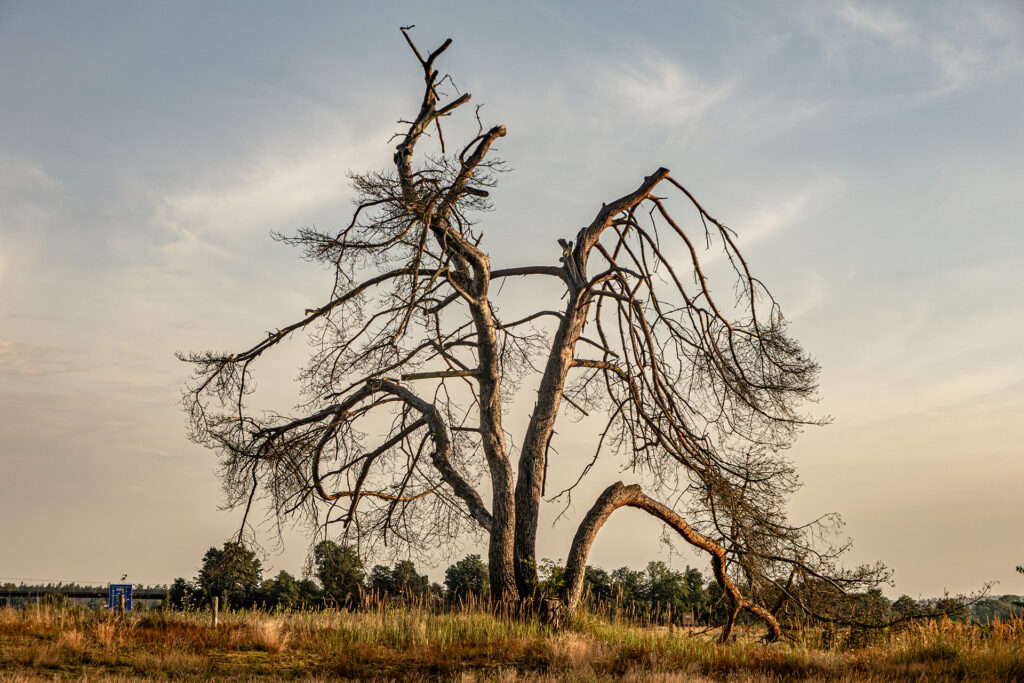
Seen through this lens, the Alzenauer Sande appeared entirely different. What once seemed like an ordinary stretch of woodland revealed itself as a quiet remnant of a much older and more dynamic past. I returned a third time, deliberately and with my camera, after a powerful supercell storm had swept through the Kahl Valley. The aftermath left behind broken trees, exposed ground, and an atmosphere that felt almost apocalyptic—harsh, fragile, and strangely beautiful at the same time.
Parking and Ways to Experience the Alzenauer Sande
The Alzenauer Sande can be explored from several directions. The easiest access is via the A45 motorway, taking the exit Alzenau Mitte. Immediately after the roundabout, turn right onto Schafweg (N50° 05.116′ E9° 02.280′). There is ample parking space here, suitable even for larger camper vans.
From this point, you cross the river Kahl and reach the Alzenauer Sande after approximately 800 meters by turning left. Alternatively, you can keep right and walk towards the motorway to gain a very different set of impressions, shaped by openness and exposure.
Another approach leads from Hörstein, via a narrow paved forest road. This route brings you to a smaller parking area (N50° 03.637′ E9° 02.847′). From there, a short path of around 160 meters leads directly toward the motorway and into a section of the Alzenauer Sande that feels markedly different—more intimate, more enclosed, yet no less distinctive.
Background: A Rare Inland Sand Landscape in Central Europe
Beyond their origin as former wandering dunes, the Alzenauer Sande are remarkable as one of the few remaining inland sand ecosystems in this part of Central Europe. Such landscapes were once more widespread, shaped by wind, sparse vegetation, and extreme soil conditions. Over time, most of them disappeared due to forestry, agriculture, and settlement.
What makes the Alzenauer Sande special today is their ecological tension: dry, nutrient-poor sandy soils meet patches of woodland, creating a habitat where only highly adapted plant and animal species can survive. Many of these species are specialists, relying on open sand, sparse shade, and warm microclimates. Without careful protection, this balance would quickly be lost, as natural succession would turn the dunes into dense forest.
As a protected geotope and nature reserve, the Alzenauer Sande are not preserved as a static monument, but as a landscape in constant negotiation between openness and overgrowth—between movement and stillness.