Why these forests stayed with me
Some places stay with you longer than others.
Not because they are spectacular at first glance, but because they reveal themselves slowly. The oak forests of the Spessart belong to those places. They are not loud, not dramatic, not made for quick impressions. They demand time, patience, and a willingness to walk without expecting anything in return.
My connection to these forests did not begin with a clear plan. It grew over repeated visits, early mornings, quiet paths, and long walks without a destination. What fascinated me was not a single tree or viewpoint, but the atmosphere: the weight of old trunks, the subdued light beneath the canopy, the feeling that time moves differently here.
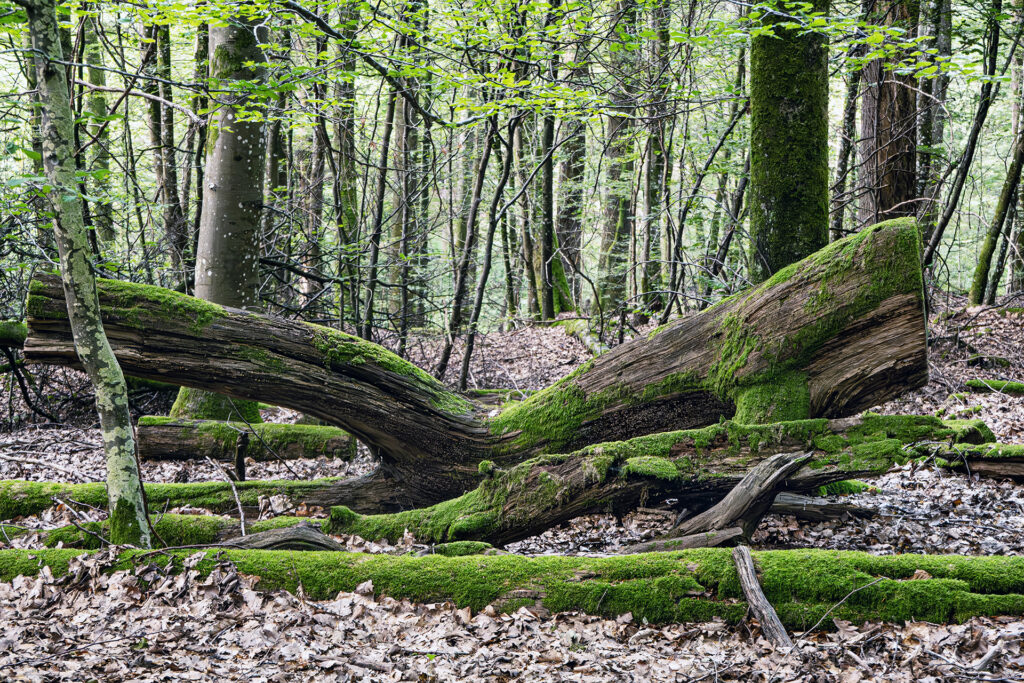
Oaks have always carried symbolic meaning – strength, endurance, continuity. But in the Spessart, this symbolism becomes tangible. These forests are not abstract ideas. They are physical, present, and deeply rooted in the landscape. Over time, they became the places where my photographic approach took shape: slow, deliberate, and focused on stillness rather than spectacle.
Three oak forests in particular accompanied this process: Metzgergraben & Krone, Eichhall, and Rohrberg. Each of them feels different, yet together they form the core of my relationship with the Spessart.
Metzgergraben & Krone
Metzgergraben and Krone feel like an introduction to the Spessart’s oak forests in their most intimate form. The forest here is dense and close, with steep slopes, narrow paths, and a sense of enclosure. Old oaks rise from the hillside, surrounded by deadwood, moss, and undergrowth that seems untouched by urgency.

This was one of the first places where I felt truly absorbed by the forest. Walking uphill on the narrow path, breathing steadily, the outside world slowly disappears. Sounds soften, the light becomes filtered, and the forest begins to dictate the pace. Encounters are rare, and even wildlife feels closer than human presence.
Photographically, Metzgergraben and Krone are about proximity. There are few wide views, but countless details: bark structures, fallen branches, subtle light on leaves and soil. It is a place that rewards attention rather than movement.
📋 At a glance – Metzgergraben & Krone
- Region: Spessart, Lower Franconia
- Forest type: Old-growth oak forest
- Character: Dense woodland, steep terrain, deadwood, quiet atmosphere
- Best time: Early morning, autumn
🚗 Access & Parking
- Parking: N49° 55.664′ E9° 23.847′
(49.927733, 9.397450 – Google Maps compatible) - Situation: Informal roadside parking on a left-hand bend when coming from Rothenbuch, shortly before the road crosses the Steinbach. Usually quiet and unproblematic.
- Exploration: A narrow path branches off directly from the parking spot and climbs steeply uphill. Following this trail for about one kilometre leads straight into the core areas of Metzgergraben and Krone, covering the main highlights along the way.
Eichhall
Eichhall feels different from the very first steps. Where Metzgergraben is dense and intimate, Eichhall opens up. The forest breathes more freely here. Tall oaks stand with greater spacing, creating a sense of rhythm and verticality. The ground feels calmer, the space more structured.
What makes Eichhall special is not a single motif, but the repetition of forms. Walking through the forest, the eye adjusts to patterns: trunks rising in parallel, light breaking through at regular intervals, shadows stretching across the forest floor. It is a place where the forest becomes a space rather than a collection of trees.

From a photographic perspective, Eichhall invites restraint. Compositions emerge slowly. Often, the strongest images appear away from the main paths, where the forest regains its quiet balance.
📋 At a glance – Eichhall
- Region: Spessart, Lower Franconia
- Forest type: Mature oak forest
- Character: Open structure, strong vertical lines, spatial depth
- Best time: Soft light, overcast days, autumn
🚗 Access & Parking
- Parking: N49° 55.589′ E9° 23.966′
(49.926483, 9.399433 – Google Maps compatible) - Situation: Large forest parking area with space for several cars and even larger camper vans. Easy access.
- Exploration: From the parking area, the main path leads into the forest. After around 500 metres, it is worth leaving the trail to the left, as the right-hand side offers little of interest. The most rewarding impressions emerge once you move directly through the woodland, away from the established paths.
Rohrberg
Rohrberg is less immediately inviting than the other two forests. The proximity to the motorway and the utilitarian parking area create an unromantic first impression. Trucks often stop here overnight, and the atmosphere at the parking spot itself feels functional rather than inspiring.
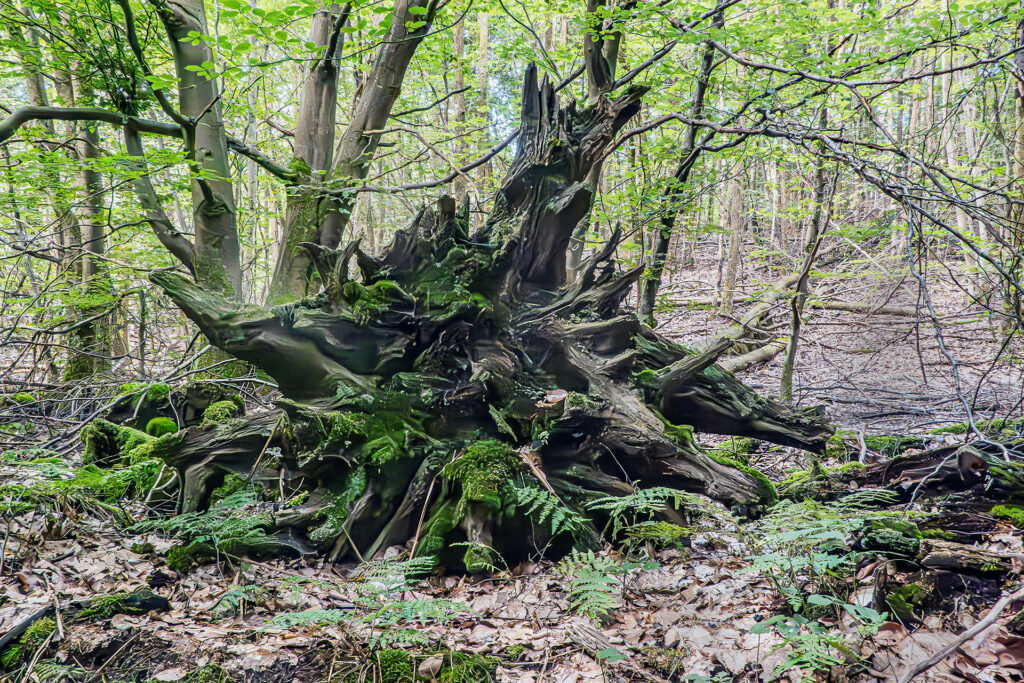
But once you leave the immediate surroundings behind, Rohrberg reveals a different character. The forest opens into a landscape shaped by history. Old oaks stand more isolated, some with sprawling crowns, others marked by age and past land use. This area bears traces of traditional grazing and forest management, visible in the spacing and form of the trees.
Rohrberg requires orientation and patience. Paths are less intuitive, and a map is essential. In return, it offers a quieter, more contemplative experience – one that feels less curated and more raw.
📋 At a glance – Rohrberg
- Region: Spessart, Lower Franconia
- Forest type: Historic oak woodland
- Character: Open structure, solitary old oaks, traces of traditional use
- Best time: Morning hours, calm weather
🚗 Access & Parking
- Parking: N49° 53.493′ E9° 24.765′
(49.891550, 9.412750 – Google Maps compatible) - Situation: Easily accessible parking area close to the motorway. Often used by truck drivers overnight and therefore not particularly atmospheric.
- Exploration: Despite the surroundings, this is the only viable starting point for exploring Rohrberg. A circular walk through the area is possible from here; bringing a hiking map is strongly recommended.
Why the oak forests of the Spessart shaped my photographic journey
Over time, these oak forests became more than destinations. They turned into places of return. I found myself coming back in different seasons, under changing light, often without the intention of photographing anything specific. And yet, these were the places where my photographic language slowly emerged.
What remained from earlier ideas was not movement, not storytelling through sequences, but the still image. The drone became a tool not for filming, but for gaining perspective. Aerial still photography allowed me to observe the forests as structures and rhythms rather than scenes unfolding over time.
For now, photography is the medium that best reflects how these forests feel to me: calm, patient, and enduring. What the future may bring remains open. But the oak forests of the Spessart will always mark the point where this journey truly began.